

TOFU orchestration is the largest investment
Across our customers, the biggest area of AI investment we're seeing is top of funnel.
The plug-and-play AI SDR? We haven't seen it deliver.
The orchestrated, AI-enabled SDR is a different story.
It does require a human in the loop. It does require a real point of view and strong positioning. But once those are in place, we can automate a significant amount of the work and the results are real.
.png)
This isn't actually new.
In 2016, we built what I'd now call an AI-enabled SDR function at Zendesk, except we were using Eloqua dynamic content, segmenting by title, role and industry. The content wasn't written by AI, but the bones were exactly the same:
- Aggressive segmentation and data enrichment
- Customized messaging based on who you were talking to
- Routing to the right AE with enough context to have a genuinely compelling conversation
And it worked. Our fake SDR had a LinkedIn profile and she booked meetings. It was rad.
It always comes back to basics. AI has just made the enrichment cheaper, the signal identification faster, the messages more personalized, and the seller activation smarter.
The fundamentals haven't changed. The leverage has.
What it actually takes to build an AI-enabled GTM engine
The opportunity we have in RevOps is to create a full AI-enabled GTM team.
What does that look like? Let me break this down specifically for top of funnel.
There are three layers, and you need all of them.
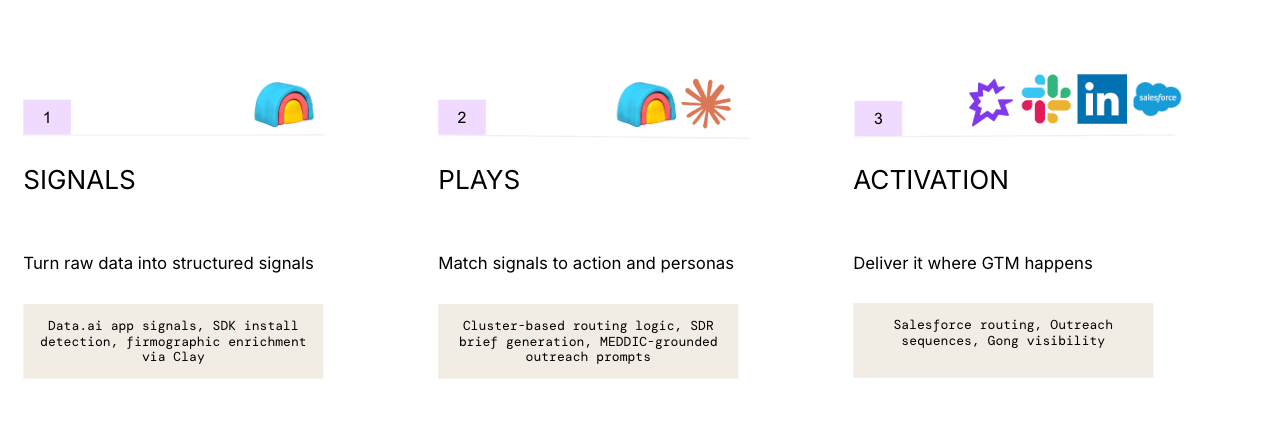
1. Data infrastructure: turning raw data into signals
This is where everything starts. And I have a strong opinion here: build this yourself. Don't outsource your intelligence to a tool that sells the same generic signals to every company in your space. You can layer in third-party tools, but they shouldn't be the whole story. The signal layer is where differentiation happens.
Here's what I mean by signals vs. raw data: I don't care that a prospect has ten users. I care that they grew from five to ten in the last thirty days. That's a doubling. That tells me something is happening. That's a signal.
The kinds of signals we're mixing and matching:
- Product signals
- Marketing engagement
- Demographic data
- Company activity
- Hiring trends
- Executive changes
- Regulation changes
- Geographic expansion
I can't tell you exactly what to build here. Make this company specific, take risks. Do this well and it's what makes you better than your competition. If it's generic, you'll blend in.
This is your first- and third-party data working together. And you need to track it in a scalable way. Our typical recommendation: use something like Clay to test and collect signals quickly. Then for the ones that prove out and should be running company-wide, get them into a data warehouse like Snowflake and let them run at scale.
2. The play: recommended action based on signals
Once you have signals, you need a system for deciding what to do with them.
That's the play: the recommended action, the messaging angle, the channel. And I cannot stress this enough - plays are not set-it-and-forget-it. The teams seeing the highest conversion rates are the ones testing and iterating constantly. This is the growth marketing mindset we need to bring to SDR teams.
It’s also your intelligence. It should be yours.
A great example: Figma looks for an increase in developer seats on their platform over the last 30 days, combined with attendance at their developer webinar, combined with recent developer hiring at the account. Put those three signals together and you have a really clear picture. This company is investing in development, they're probably feeling the pain of design-to-developer handoff, and Figma solves exactly that. The messaging writes itself.
Another great example: Intercom looks for an increase in customer cases, an increase in number of seats, and a decrease in their customer’s customer NPS score. That tells them that the company is experiencing growth, and can’t keep up. Insert FIN. Sells itself.
3. Activation: getting it into the hands of sellers
None of this matters if it doesn't reach your sellers in a way they'll actually use the insights. Meet them where they are.
We've seen this done a few different ways across our customers:
- Salesforce-centric: Signal data goes into custom objects, gets tracked, converts into opportunities. Clean, measurable, good if you’re already heavy salesforce users.
- Slack-first: Push notifications, sellers can act and respond directly in Slack. Fastest to stand up, but harder to track play effectiveness. A great starting point, just make sure you build toward measurement.
- Custom UI: Some teams have built their own workflow layer on top of all their systems. Most control, most investment.
Take Intercom (Fin) for example. They've invested in building out a control center for their reps that lives on top of their company documentation, intelligence, Salesforce data, product data and more. They can use it to understand their pipeline health, draft messaging and more.
All three can work. It really comes down to your internal culture and how your sellers actually operate.
Where this is all going
This is genuinely the most excited I've been in my career. It's the most fun I've had as an operator. And we have the opportunity as revenue operators to be the most strategic function. And this isn't hyperbole.
Everything I've described here is scoped to top of funnel, but apply this same thinking to CSMs and it scales. Instead of leads, we’re sending expansion opportunities or renewal risk alerts.
The goal isn't just to make your sales team more productive (though that's a great outcome). The goal is to own the intelligence. To make that intelligence a competitive advantage. To push the boundaries of what we can build and operate across the entire go-to-market motion.
It's time to build an AI-enabled GTM engine.
Happy building, operators.