

What is headless CRM, really?
In 2026, headless means something more specific than portals and communities. It's an architectural approach where your CRM stops being the place reps work and becomes a layer running quietly in the background. Salesforce still holds the data and enforces the rules, but reps never have to open it - they're working directly in Slack, Gong, or an AI agent like Chat GPT or Claude instead.
And it's worth noting that headless CRM has a body count already. Clari built an entire category doing a version of this over a decade ago, pulling forecasting out of Salesforce and running it in its own layer. It worked, until the sync didn't: changes cached for up to 15 minutes before pushing back to Salesforce, with no validation that Salesforce would even accept them. Reps would update a deal in Clari, watch it silently revert, and assume they were losing their minds.
The same happened with marketing automation - plenty of teams eventually cut their MTA out of lead routing entirely because a five-minute sync lag was costing them live leads.

Slack-native deal management, pre-call briefings emailed automatically beforehand, handoff processes that fire without a rep manually updating a field - these things are already live and successful for some teams.
That said, when Parker Harris (the guy who BUILT the lightning UI, btw) says you should you never log into Salesforce again, we have to (respectfully) disagree.
Why Salesforce isn’t Dead
To say you should stop logging into Salesforce altogether is a bit like saying you should handle your mortgage, your Spotify queue, and a fight with your insurance company all through iMessage. Every conversation about headless should start with the question, ‘where is this particular job best done?’.
Asking an agent how an account is doing and getting a conversational answer back is a job that probably wants to leave the CRM. Updating Forecast Category on an opportunity, where the difference between Pipeline, Best Case, and Commit carries real revenue consequences for your manager's call? That job benefits from seeing the options in front of you with a clear signal that you own the number, not describing your confidence level and hoping the AI maps it right.
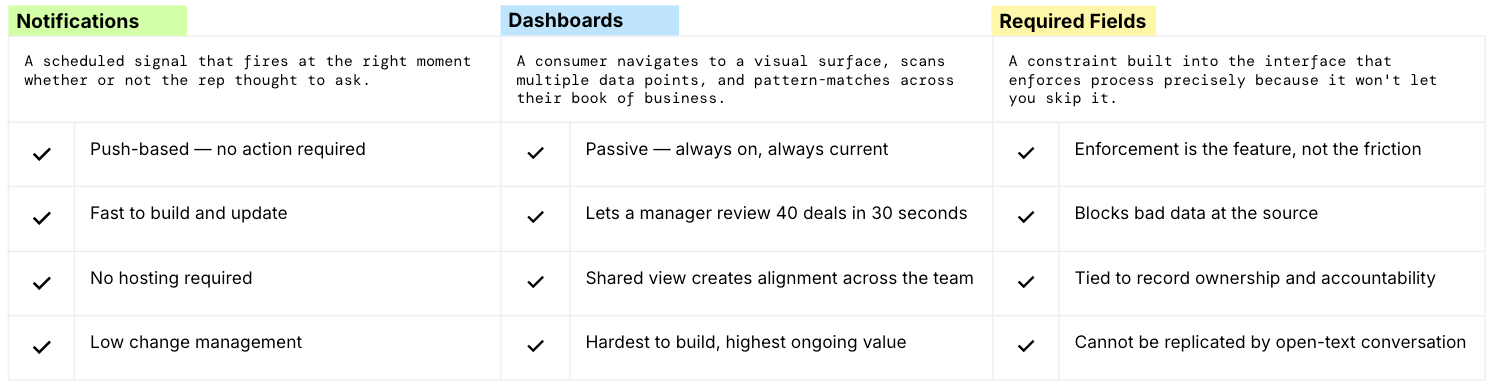
This also shows up in how you think about delivery methods. A notification, a dashboard, a required field, and a forecast commit are not the same interaction, and a conversational interface is the wrong answer for most of them.
Worth remembering, too: the traffic isn't all one-directional. We know of at least one fast-growing company migrating onto Salesforce this year, from a lighter-weight CRM, because they'd outgrown what they had. Headless isn't a one-way exit ramp. Sometimes the platform is the upgrade.
So, will we see more jobs move into a conversational interface like ChatGPT? Yes! Should all jobs move there? No!
Sorry Marc and Parker, we think we will keep logging in for a while longer.
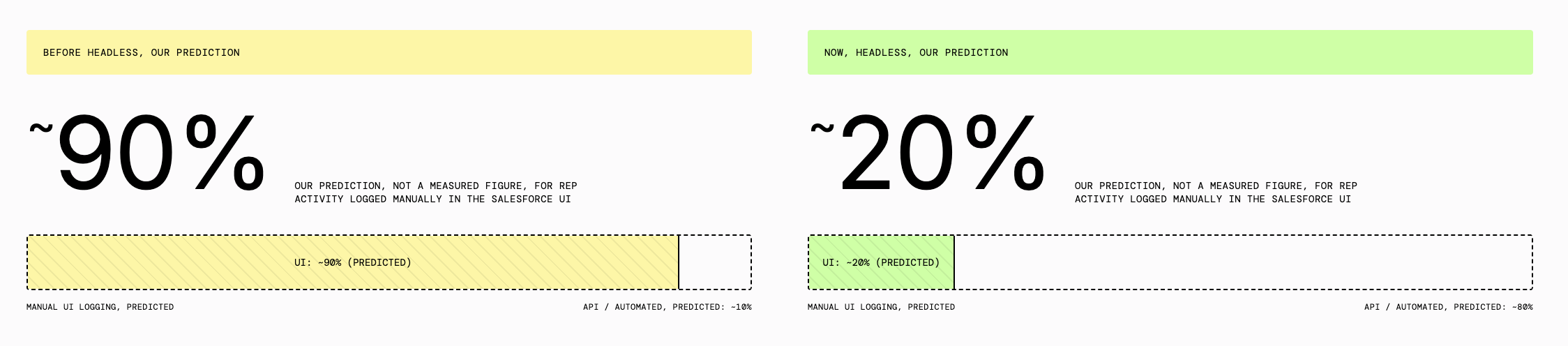
The complexity no one is talking about
Another reason we hear the whistle of the hype train is all the extra infrastructure it takes to make their existing UI work.
Think of the CRM as a brain, a face, and a skull. The brain is the logic, while the face is the interface reps see. Everyone talking about headless is excited about swapping the face, but almost nobody's talking about the skull: the guardrails, validation, and permission structure Salesforce has spent close to 25 years building in. If you change out the face, the skull still needs to exist somewhere.
There's also a real difference between a headless layer that reads and one that writes. A chat interface that lets your sellers ask questions across your CRM, data warehouse, and enablement tools is low-risk. It's not taking any actions, so it can't break anything the skull is protecting. The risk shows up the moment that layer starts writing back.
Split the write side into two buckets and the risk gets clearer:
Bucket one: true no-UI work, reps operating straight through an agent or CLI with no interface at all, which tends to route around whatever governance Salesforce was enforcing, forcing teams to retrofit guardrails after the fact. (credit: Karan Singh)
Bucket two: a layer built on top of Salesforce, vibe-coded rather than productized.
Compare either bucket to a tool like Gong, which has no ambiguity around what it does or doesn't touch, and you see where you might be missing critical guardrails. (credit: Karan Singh)
The pros of headless CRM
Improved GTM experience. Decoupling the user experience from the underlying platform allows you to evolve workflows at the speed of your business, meeting your sellers, and ultimately your customers, where they are instead of where your software thinks they should be. (credit: Keith Jones)
Talent security. By designing intuitive, purpose-built experiences instead of forcing teams through vendor-defined interfaces, organizations can better attract, retain, and empower top GTM talent. (credit: Keith Jones)
Speed and flexibility. Technical teams can iterate faster without being constrained by CRM platform limitations.
Reduced cognitive load. By presenting only relevant information in context, headless approaches can reduce the overwhelming nature of traditional CRM interfaces with hundreds of fields and complex layouts.
Future-proofing for AI. Headless architectures align well with emerging AI agent workflows. This isn't just a customer trend either. Salesforce itself has been pushing in this direction, framing the API as the actual interface and building toward a world where Slack (or something like it) does most of the talking. When the platform vendor is moving the same direction as the buyers, that's a real signal - not just hype.
The cons of headless CRM
Strong foundations required. Headless doesn't fix a shaky CRM; it exposes it faster. Teams trying to headless their way out of weak account hierarchy or a messy object model don't get the gains they were promised. Instead, they get a second maintenance problem stacked on top of the first.
Maintenance complexity. Multiple systems now have to agree with each other. If one team updates the MCP integration, but nobody tells the team that owns validation rules, a required field stops getting populated because the workflow doesn't know it exists. This isn't a tooling problem so much as an org chart problem: most RevOps teams don't have in-house engineers or architects, but they're being asked to DIY a tech stack that assumes they do.
API limitations and costs. Organizations hit API call limits faster with headless approaches than they expect, creating unplanned costs and technical ceilings that don't show up until you're already committed.
Permissions and security risks. Salesforce's sharing model is genuinely strong, and it doesn't automatically travel when data moves into Slack or a custom interface. There are already real exposure incidents on record because nobody rebuilt the permission logic on the new surface. Add AI-generated summaries and reports into the mix and you've got a second problem: if an agent hallucinates or gives two people different answers to the same question, how does anyone know which version is the true one?
Product maturity concerns. Salesforce had to retrofit its own guardrails onto AgentForce after AI-driven data entry started going wrong, at real cost to customers, and the efficiency numbers getting pitched right now don't hold up well under scrutiny. Vendors are selling double-digit-hours-saved-per-day, but the actual return, once you subtract the time reps spend babysitting the agent, is closer to half that. None of this makes headless a bad idea. It makes the ROI timeline longer and less certain than the pitch suggests, often 4 to 5 years out, which is a long bet in a market that changes every year.
Governance debt. Give an entire GTM team unrestricted build access and you're going to get a bunch of worse tools rather than one better one. We've seen a teams end up running eight different quoting tools, each with its own logic, several of them actively breaking, with nobody able to say which ones were even still being used.
What does headless look like at enterprise scale?
The enterprise teams doing this well aren't killing Salesforce. They're building a tightly scoped cockpit on top of it.
One example: a well-known enterprise SaaS company (for whom we don’t have logo rights 😉) built their own internal hub, sitting primarily on Salesforce and Snowflake, giving reps a single place to see their to-do list, at-risk deals, and a set of agents that can execute specific actions.
The team behind it was asked directly: knowing what you know now, would you buy this instead of building it? The answer was a flat no. Are you getting rid of Salesforce? Also no. Not because they got everything right on the first try, but because they were disciplined about the split: build the things that are genuinely a competitive advantage, buy or keep using the platform for everything else. Salesforce is still the backend. Reps still log in for some actions.
Staffing tells a similar story. At one company that took this seriously, the first four hires on the team responsible for GTM systems weren't engineers, they were product managers brought in deliberately constrained by their own lack of engineering ability, so they'd spend their time with stakeholders and end users figuring out what was actually worth building, instead of just shipping whatever was loudest that week.
It also complicates the idea of hiring a single "GTM engineer" to solve this. More than one team we talked to described trying to hire that exact unicorn (sales-fluent, technical, able to vibe-code a fix on the spot) and failing. What worked better was hiring a strong generalist operator and letting them grow into the technical side, rather than hiring for the technical side and hoping the operator judgment came with it.
The pattern holds at scale: strong foundation first, then a narrow, well-governed layer on top, staffed by people who can do both the technical build and the "is this actually worth building" judgment call.
The Bottom Line
Everyone is already headless for a portion of their work, and that will only increase in the coming years. It’s a real pattern, with real benefits for teams. That said, it isn’t a paradigm shift to a pure chat interface for rep work, nor is it the default next step for every RevOps or GTM org.
The current LinkedIn consensus that everyone needs to hire builders and become a builder is doing the industry a disservice. A GTME will give you a real initial lift by solving a handful of visible use cases fast, but that's not the same as a durable capability, and it's not the solve for the underlying problem.
If you want to be one of the teams who gets this right, do these three things:
01. Start with a clean data foundation
02. Target jobs that actually benefit from a purpose-built surface
03. Hire the engineering capacity to own what you build (whether that means a builder, or an operator who can grow into one)
The better question isn't 'should we go headless?', it's which specific jobs in our sales process are badly served by the native interface, and do we have what it takes to build something better for those jobs without breaking everything else?
Admittedly, that question is harder and less exciting. Which is probably why the headless conversation keeps getting framed as a vision instead of a tradeoff.